What Somalia Could Become in the Next 10 Years — If We Choose to Lead
By Abbas Gassem | Gateway2Somalia | May 2026
Let me start with a statement that will offend almost everyone: Somalia’s greatest problem is not al-Shabaab, not drought, not clan politics, not foreign interference, and not poverty. Somalia’s greatest problem is that we keep electing the wrong kind of leadership — and then asking everyone else why our country is not working.
Every five years we go through the same ritual. The presidential term creeps to an end. A debate erupts over whether to extend it by another year. Then a fight breaks out over whether to use the 4.5 clan formula or one-person-one-vote. The Federal Government and the Federal Member States position themselves like rival kingdoms. Donors threaten. Diplomats fly in. Mogadishu fills with hotel-summit communiqués. Al-Shabaab waits, profits, and takes back another district. And the children of Baidoa go hungry.
Meanwhile we are sitting on the longest coastline in mainland Africa (3,300 km), one of the most strategic locations on the planet, 8.9 million hectares of cultivable land, up to 30 billion barrels of seismic-indicated hydrocarbons, USD 2 billion in annual diaspora remittances, a population under 35 that hustles harder than any I have met anywhere, and an EEZ larger than the country itself. We are not a poor country. We are a misled country.
This is a Gateway2Somalia article, but I am speaking to a wider audience. I am speaking to the global leaders, aid organisations, sovereign investors and economic decision-makers who have spent more than USD 50 billion on Somalia over three decades and who are quietly asking themselves whether there is a country here to invest in, or only a problem to manage. I am also speaking to Somalis — at home and in the diaspora — who already know everything I am about to say but need someone to say it plainly. There is a Somalia worth building. The next ten years will decide whether we build it or simply outsource our future.
1. The Election Ritual: Why We Keep Failing the Same Test
In May 2022, Hassan Sheikh Mohamud was elected president — through the 4.5 indirect clan-delegate model — after the previous administration tried to extend its own term and triggered armed clashes in Mogadishu in 2021. Three years later, in December 2025, Mogadishu went to direct universal-suffrage local elections for the first time since 1969. By May 2026, South West State followed. On paper, this is historic progress. In practice, Puntland and Jubaland have largely boycotted the process, the Somali Future Council declared political dialogue collapsed in February 2026, and the opposition is openly warning that after 15 May 2026 they will treat the president as an ordinary citizen.
We are heading, in slow motion, toward 2021 all over again — except this time al-Shabaab has already retaken Adan Yabaal, Moqokori and Mahas, and the militants’ annual revenue is estimated by the U.S. Congressional Research Service at USD 200 million from taxation and extortion alone. Transparency International placed Somalia 181st of 182 countries on its 2025 Corruption Perceptions Index, with a score of 9 out of 100. The Independent Anti-Corruption Commission has been dormant since October 2022.
So let me be blunt: the argument over 4.5 versus one-person-one-vote is not the real debate. The real debate is whether we have leaders willing to sign and honour an electoral pact that all federal member states — including Puntland and Jubaland — accept, with an independent results-adjudication mechanism. That is a 90-day exercise in political courage. We have had fifteen years to do it. We have done it zero times.
Right leadership in 2026 is not about who wins the presidency. It is about whether the winner is recognised. Without that, every other reform I am about to describe collapses on contact with reality.
2. The Most Strategic Coastline No One Has Built
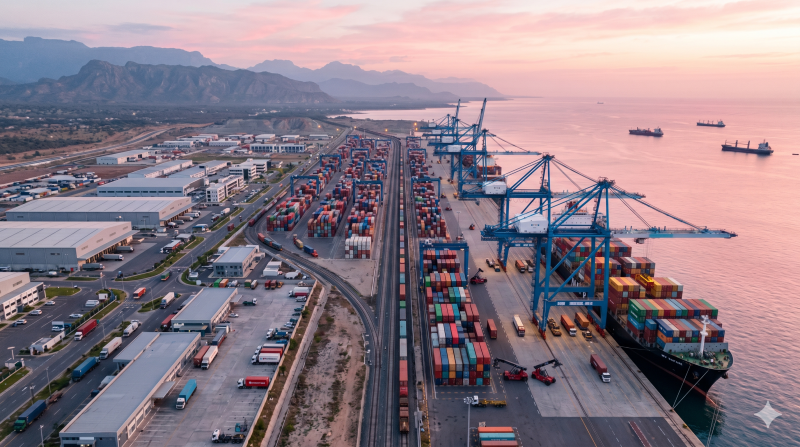
Look at a map. From Bosaso or Hobyo, you can reach the Gulf countries in 4 hours by air, India in 5, Europe in 8, southern Africa in 8, and east Asia in 7–8. By sea, we sit astride the Gulf of Aden — one of the most consequential shipping chokepoints on earth, through which roughly 12% of global trade and a large share of Europe–Asia container traffic passes. We are the natural transhipment hub for central and east Africa. We are simply not behaving like one.
Today, when Mombasa, Dar es Salaam or Djibouti needs to move containers globally, the routing typically passes through Jebel Ali in Dubai, which handled 15.5 million TEU in 2024 and accounted for nearly 18% of DP World’s global throughput. The detour adds at least a day of sailing, additional handling cost, and a strategic dependency on a port outside Africa. Tanger Med in Morocco — Africa’s busiest port — handled 10.2 million TEU in 2024. There is no equivalent on Africa’s eastern flank. That is the opportunity.
The Hobyo / Bosaso deep-sea port proposition
My recommendation to global leaders, sovereign wealth funds and DFIs is concrete. Somalia should procure, on a single transparent international tender, a deep-sea port concession on the basis of:
- Location: Hobyo on the Indian Ocean coast (or Bosaso on the Gulf of Aden) — both offering natural deep water and proximity to Indian Ocean main lines without the strait detour to Jebel Ali.
- Concession: a 99-year build-operate-transfer agreement, modelled on the most successful Gulf and Moroccan precedents, with explicit no-interference covenants and binding international arbitration in London or Singapore.
- Fiscal terms: a low corporate tax (5–10%) free-zone regime for tenants, on the model of Jebel Ali Free Zone and Tanger Med, but with stronger beneficial-ownership transparency than either.
- Rail and air integration: phased rail corridors to Ethiopia (via Galkayo), Kenya (via Kismayo), and South Sudan; air cargo joint venture with Ethiopian Airlines and one or two Gulf carriers to anchor electronics and pharmaceuticals.
- Sovereign protection: a constitutional or parliamentary super-majority lock so that no single president — including me, if I were ever foolish enough to run — can unilaterally tear up the concession.
What the numbers could look like
A facility designed to ramp from 1–2 million TEU in year five to 5–8 million TEU over twenty years — still less than half of Jebel Ali’s 2024 throughput — would, at conservative concession and handling economics, generate USD 1.5–3 billion in annual revenue once mature, with multiplier effects through the free zone, customs, logistics jobs, fuel, hospitality, and downstream manufacturing. For a country whose 2024 GDP is approximately USD 12.1 billion, a single piece of infrastructure can plausibly add 10–20% to GDP within a decade. That is the math the world keeps missing about Somalia.
And the strategic point matters as much as the money. Re-routing Africa’s east-coast cargo through a Somali transhipment hub shortens the Europe-via-Suez route, reduces East African exporters’ dependence on Jebel Ali, and gives the entire EAC bloc — which Somalia joined in March 2024 — a coastline with global-scale port capacity. That is a contribution to East Africa’s growth that goes far beyond Somali borders.
Light industry and value-added free zones
With a population of around 17–18 million, Somalia is not going to absorb labour the way a country of 100 million can. That is not a weakness — it is a design constraint that fits modern, robotics-enabled, capital-intensive light industry rather than mass low-wage manufacturing. The Free Zone strategy should focus on assembly, repackaging and value-add for re-export — electronics finishing, fish processing, agro-processing, pharmaceuticals — anchored to East Asian and Chinese partners with the capital and the equipment, and to EAC and AfCFTA rules of origin for downstream market access.
3. The Blue Economy: Stop Letting Foreign Trawlers Eat Our Lunch
Somalia has approximately 3,300 km of coastline and an Exclusive Economic Zone of around 830,000 km² — larger than the country’s land area. The World Bank estimates we could sustainably harvest more than 200,000 tonnes of fish a year. UNODC and ENACT Africa put the cost of Illegal, Unreported and Unregulated (IUU) fishing in our waters at approximately USD 300 million a year — money that today leaves our sea in foreign industrial hulls and never touches a Somali coastal village.
What right leadership does here
- Ban industrial trawling in the EEZ. Period. South West, Galmudug, Puntland — all of us. The Ministry of Fisheries already banned trawling in federal waters; right leadership extends it nationally and enforces it.
- Build a satellite + drone + patrol-vessel surveillance grid co-operated with the Indian Ocean Tuna Commission, EUNAVFOR Atalanta, UNODC and the Combined Maritime Forces. The technology exists; the licences are already issued. What is missing is one signed national IUU agreement.
- Issue licences only to Somali-flagged or Somali-joint-venture vessels with onshore processing requirements — every tuna landed in a Somali port should be filleted, frozen and exported from a Somali processing line, not from a foreign factory ship.
- Co-management with coastal communities. Roughly 50 fishing villages along our coast deserve formal inshore-zone priority access rights, modelled on Mozambique’s community-fishing councils, so that the fight against IUU has 50 organised constituencies behind it, not just a ministry in Mogadishu.
At full capacity, the blue economy is a USD 1.5–2 billion annual industry. It is the fastest, cleanest fiscal opportunity Somalia has — it does not need a peace dividend in the south, it does not need first oil, it does not need foreign reconciliation. It needs surveillance, licensing transparency, and the political will to enforce our own sovereignty over our own water.
4. Oil, Gas, Gold and Rare Earths: Drill Smart, Then Lock the Vault
Oil and gas: drill while it still has value
TGS seismic data from 2014, supplemented by Turkish Petroleum Corporation (TPAO) 3D surveys in 2024–25, suggests potential reserves of up to 30 billion barrels across offshore blocks. Coastline Exploration’s CEO has spoken publicly of “tens of billions of extractable barrels.” The first Somali offshore drilling campaign is being prepared for 2026–27.
Here is the uncomfortable truth: oil is a depreciating asset. The UAE quietly understood this years ago when it pushed for higher OPEC quotas — they are racing to monetise reserves while hydrocarbon prices still command meaningful margins. Somalia does not have the luxury of waiting another decade. We should drill, and drill quickly, under transparent contracts, with multiple international operators (Turkish, American, British, Norwegian) competing for blocks rather than a single national champion that becomes a single point of corruption.
The non-negotiable: a Sovereign Wealth Fund before first oil
Every African resource economy that has gone wrong — Nigeria, Equatorial Guinea, Angola, parts of Mozambique — went wrong because the institutional architecture that should have channelled revenues to future generations was built after first oil rather than before. Right leadership designs the vault before pouring the gold into it. Specifically:
- A Norwegian-Botswana hybrid SWF: Norway’s Government Pension Fund Global for the discipline (fully transparent, parliamentary oversight, world-class external management) and Botswana’s Pula Fund for the realism (a fragile-state context, not a Scandinavian one).
- Statutory 3–4% sustainable spending rule, automatic, counter-cyclical, written into the constitution. No president can override it.
- EITI accession before first commercial production — every contract, payment and beneficial owner published, ideally before the first well is spudded.
- Federal–FMS revenue-sharing formula agreed in advance, so that Puntland, Galmudug, South West and Jubaland do not fight over the cake the day after it is baked.
Rare earths, uranium, gold — the strategic minerals window
Somalia’s mineral story is older and bigger than most realise. The U.S. Geological Survey’s 1982 evaluation flagged uranium at Alio Ghelle, rare earth elements and silica sand in the coastal dunes near Marka and Mogadishu, banded iron, tantalum (simpsonite on the beaches east of Berbera), gold east of Bardhere, columbite, lithium-bearing pegmatites, and substantial phosphate deposits. Geological summaries cite estimated uranium reserves of approximately 10,200 tonnes, with around 7,600 tonnes potentially commercially recoverable.
As major economies diversify away from current rare-earth supply chains — chiefly to reduce dependence on a single producer — Somalia has a narrow window to attract serious mining investment under modern, beneficial-ownership-disclosed licensing. And — this matters — the goal should not be to ship raw ore. Tantalum should be concentrated in-country. Phosphate should feed a Somali fertiliser industry that supplies our own farmers before exporting the surplus. Gold should be refined and assayed in Somalia, not in transit hubs that capture our margin. Value addition is not a slogan; it is the difference between being a quarry and being an economy.
5. Agriculture: Feed Ourselves First, Then Feed the Gulf
Somalia has 8.9 million hectares of cultivable land (FAO, World Bank) — of which approximately 2.3 million hectares are suitable for rain-fed crops and 700,000 hectares for irrigated crops along the Jubba and Shabelle rivers. Today only about 110,800 hectares are actually irrigated — less than half of what we irrigated before 1991. Maize yields average around 750 kg per hectare, compared with a global average closer to 5,000 kg per hectare. Drought events have nearly tripled in frequency over the last 30 years.
In 2025 the Deyr-season cereal harvest in southern Somalia was 83% below the long-term 1995–2025 average (FAO). Six and a half million Somalis — one in four — are in IPC Crisis or worse. This is not a country that lacks farmland. It is a country that lacks irrigation, finance, mechanisation, cold chain, and a leadership able to treat agriculture as strategic infrastructure rather than emergency relief.
What an actual food-security plan looks like
- Rehabilitate 200,000+ hectares of irrigation along the Shabelle and Jubba within a decade — roughly doubling pre-civil-war irrigated capacity. A phased USD 250–400 million programme can bring irrigated area close to its pre-1991 baseline.
- Self-sufficiency in maize, sorghum, sesame, vegetables, bananas and citrus within 7–8 years. Lower Shabelle (30% of national output) and Juba Valley (25%) are already the productive heartland. Bay Region adds another 20%.
- Export targeting the GCC. The Gulf is a USD 130+ billion food import market and depends heavily on shipping lanes that pass our coast. Somali sesame, bananas, citrus, livestock and processed fish should be on supermarket shelves in Riyadh, Doha and Dubai within a decade, supported by GCC-aligned phytosanitary protocols and direct cold-chain from Berbera, Mogadishu and Kismayo.
- Modern mechanisation and improved seed access: today only 15–20% of farmers use improved seeds and over 80% of farming is still manual. This is not a peasant economy by destiny; it is a peasant economy by neglect.
6. The 17 Million Advantage
Most African economic models assume that growth comes from large populations. Somalia, with approximately 17–18 million people on a land area roughly equivalent to France (637,540 km² to France’s 643,801 km²), runs the opposite proposition: a small, mobile, entrepreneurial, multilingual diaspora-connected population on a strategically located landmass with under-utilised resources. That is a structural advantage, not a weakness.
What this should mean for GDP per capita by 2040
Today, France’s GDP per capita is approximately USD 45,000–50,000 (nominal). Kenya’s is approximately USD 1,670 (World Bank, 2025). Somalia’s is approximately USD 700–800 (World Bank, 2024). The right question is not whether we can be France in 2040. The right question is: with our endowment per capita, where could we credibly be?
| Country | GDP per capita today (USD, nominal) | Realistic 2040 scenario | Multiplier |
|---|---|---|---|
| France | ~$45,000–50,000 (2025) | ~$60,000+ (steady-state growth) | ~1.3x |
| Kenya | ~$1,670 (2025, WB) | ~$3,000–3,500 (current trajectory) | ~2x |
| Somalia — current path | ~$700–800 (2024 WB) | ~$1,200 (drift, donor-dependent) | ~1.6x |
| Somalia — right leadership scenario | ~$700–800 today | ~$4,000–5,000 (port + blue economy + oil + agriculture + SWF) | ~5–6x |
My answer is uncomfortable but defensible: a Somalia that gets logistics, blue economy, hydrocarbons, agriculture and the SWF right could plausibly multiply GDP per capita five- to six-fold by 2040, reaching the USD 4,000–5,000 nominal range — roughly where Algeria, Tunisia or Ecuador sit today. That is not a fantasy. It is a maths exercise driven by per-capita endowment, port revenue, fishing revenue, oil revenue, and SWF compounding on a small population base.
7. The Numbers, on One Page
If you take only one image away from this article, take this table. It is the most boring slide in any pitch deck I have ever built — and it is the only slide that matters.
| Sector | What we have | Right-leadership target by 2036 | Annual revenue potential |
|---|---|---|---|
| Deep-sea port + free zone | No major transhipment port; trade routed via Jebel Ali (15.5m TEU in 2024) adding 1+ day & cost | New deep-sea port at Hobyo or Bosaso; 99-yr concession; Free Zone; rail to Ethiopia, Kenya, South Sudan | USD 1.5–3bn p.a. |
| Blue economy / fishing | ~USD 300m of IUU losses; <0.5% of population in fisheries | Satellite-monitored EEZ; Somali-licensed fleets only; processing onshore | USD 1.5–2bn p.a. |
| Oil & gas | Up to 30bn barrels seismic-indicated; first offshore well 2026–27 | Production by 2030; SWF-channelled; EITI from day one | USD 3–6bn p.a. at moderate production |
| Agriculture | 8.9m ha cultivable; only ~110k ha irrigated (half of pre-1991) | Modern irrigation, value-added processing, GCC-aligned phytosanitary chain | USD 2–3bn p.a. |
| Critical minerals & gold | Uranium (~10,200 t reserves), gold, REE, tantalum, lithium-bearing pegmatites (early stage) | Modern licensing, beneficial-ownership transparency, in-country processing | USD 0.5–1bn p.a. (early phase) |
| Air cargo & logistics | Single international hub at Mogadishu; underused | Hubbing with Ethiopian Airlines/Qatar/Emirates; cold-chain for fish & produce | USD 0.3–0.6bn p.a. |
Sum these conservatively: USD 9–15 billion in additional annual revenue potential, against a current GDP of around USD 12 billion. That is not aid. That is sovereign income, captured domestically, on the back of assets that already belong to us.
8. A Ten-Year Plan, Phased and Measurable
None of this happens at once. Fragile states do not multi-task. They sequence. The table below is how right leadership turns the previous sections into a programme that can be measured, year by year.
| Horizon | What right leadership must deliver | How we will know it worked |
|---|---|---|
| Short term (2026–2028) | Inclusive election pact (FGS + FMS + opposition); reconstitute the Independent Anti-Corruption Commission; pass beneficial-ownership law; sign sovereign deep-sea port concession; AUSSOM funded through 2027. | Election accepted by Puntland and Jubaland; CPI score lifts from 9 toward 15; domestic revenue grows from ~3% to 5% of GDP; first FDI commitment letters for port. |
| Mid term (2029–2032) | Sovereign Wealth Fund operational (Norway-Botswana hybrid); deep-sea port phase 1 + free zone open; first oil flowing under EITI rules; satellite IUU-fishing grid live; rail studies to Ethiopia & Kenya done. | Non-aid revenue covers 60% of recurrent budget; port handling 2m+ TEU; SWF AUM > USD 1bn; child malnutrition rates fall by 30%; FDI 3x 2025 baseline. |
| Long term (2033–2036) | Free zones in Mogadishu, Hobyo/Bosaso, Kismayo; rail corridor to Addis; agricultural self-sufficiency on staples; minerals processed in-country; al-Shabaab politically contained. | GDP per capita doubles or better; manufacturing & services > 35% of GDP; Somalia exits LDC review; first sovereign credit rating; Somali firms listed regionally. |
9. What Could Go Wrong — and How to Stop It
Electoral collapse: a rejected 2026 election turns into 2021. Mitigation: an AU/IGAD/Türkiye-mediated electoral compact, signed by FGS, every FMS, and the main opposition associations, with binding adjudication.
Security vacuum: AUSSOM under-funding plus a premature drawdown delivers the next al-Shabaab counter-wave. Mitigation: UN Resolution 2719 financing, EU European Peace Facility commitments, and a published joint AUSSOM–SNA transition matrix tied to verifiable capability milestones — not calendar dates.
Resource curse: first oil arrives before the SWF, EITI accession and an active anti-corruption commission. Mitigation: statutory pre-commitments, IMF ECF programme conditionality, and refusal by serious investors to sign Production Sharing Contracts without the governance stack in place.
Donor fatigue: OECD-DAC contributions to Somalia have already declined and U.S. FY2026 proposals point lower. Mitigation: a domestic revenue trajectory that explicitly reduces aid dependence, EAC trade integration that re-channels benefits regionally, and SWF accumulation that builds a fiscal cushion.
Foreign-power overreach: Türkiye, the UAE, the U.S., Egypt, the UK, China and Qatar all have legitimate interests in our coast and resources. The danger is not engagement — it is exclusive engagement. Mitigation: a deliberate multi-vector foreign policy that uses competition between great powers to deliver better terms for Somalia, not to convert Somalia into anyone’s proxy.
10. The Honest Conclusion: It Was Never the Problems
I want to end where I began. Somalia’s greatest problem is not al-Shabaab, drought, clan politics, foreign interference, or poverty. Those are symptoms of something simpler and harder: a leadership class that has, election after election, prioritised its own survival over the country’s. Right leadership is not about a single charismatic president. It is about a coalition of federal and state leaders, parliamentarians, civic, religious and business institutions, willing to make a small number of disciplined choices and stick to them for ten years.
That coalition would deliver an inclusive election in 2026. It would reconstitute the anti-corruption commission within twelve months. It would sign a transparent deep-sea port concession within twenty-four. It would enact the SWF architecture before first oil. It would push industrial trawlers out of our waters. It would rehabilitate the irrigation infrastructure we already built once before. It would let private capital build the manufacturing base that 17 million people deserve. And it would treat global partners as partners — not as cash machines, and not as colonisers.
Somalia’s greatest problem is not its problems. It is the leadership we keep accepting. Whether the next ten years are different is entirely a function of whether we — as Somalis, as diaspora, as voters, as business owners, as global partners — refuse to accept anything less than the leadership our potential demands.
A Call to Action
To global leaders, multilateral institutions, sovereign investors and DFIs: the next decade in Somalia is the highest-return strategic bet in the Horn of Africa. Concretely:
- Fully fund AUSSOM through 2027 under UN Resolution 2719.
- Condition concessional finance and PPP guarantees on the reconstitution of the Independent Anti-Corruption Commission, EITI accession and beneficial-ownership disclosure.
- Back a single international tender for a deep-sea port concession with 99-year terms and international arbitration.
- Provide technical assistance to design the Sovereign Wealth Fund before first oil.
- Open Gulf, EU, UK and U.S. markets to Somali livestock, fisheries and agricultural exports under predictable phytosanitary terms.
To Somalia’s leadership — federal, state, parliamentary, civic, religious and business: the next ten years will not be judged by your speeches. They will be judged by whether the children born in 2026 attend functioning schools in 2036, whether their parents fish under a Somali flag, whether their grandparents return to villages no longer governed by al-Shabaab, and whether the GDP per capita of a Somali in 2040 is closer to a Kenyan’s of 2025 or a Tunisian’s of today. The endowment is in place. The math is in our favour. The only missing variable is us.
About Gateway2Somalia
Gateway2Somalia is a thought leadership platform covering Somalia’s economic transformation, investment opportunities, and East Africa’s emerging markets. Founded by Abbas Gassem, CEO of Libaax Motorcycle & Spare Parts.