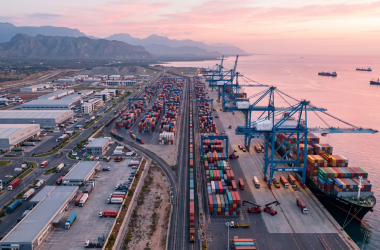
In the first week of March 2026, the price of a litre of petrol in Mogadishu surged from roughly $0.60 to over $1.50. In some parts of the city, traders reported prices as high as $1.75. The increase happened in days, not weeks.
The cause was not local. On 28 February, the United States and Israel launched joint air strikes on Iran. Iran’s retaliatory attacks targeted shipping, ports, and oil infrastructure across the Persian Gulf. The Strait of Hormuz — through which more than 20 percent of the world’s oil passes — effectively closed. The International Energy Agency called it the largest supply disruption in the history of the global oil market. Brent crude surged past $106 per barrel. The IEA coordinated the largest emergency oil release in history: 400 million barrels from strategic reserves across 32 countries.
For oil-importing countries with no strategic reserves, no domestic refining, and no alternative energy infrastructure, the shock was immediate and devastating.
Somalia is one of those countries.
The Human Cost: Tuk-Tuks, Two-Wheelers, and the Daily Struggle
In Mogadishu, the fuel price surge hit the people who can least afford it first.
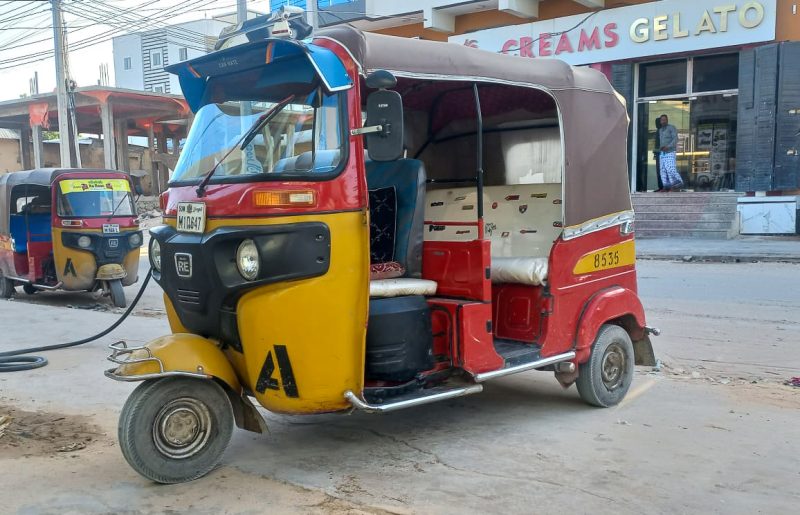
Tuk-tuk drivers — known locally as bajaj operators — are the backbone of the city’s transport system. They operate on thin margins: earning a few dollars a day, spending a significant portion on fuel. When petrol doubles in price overnight, their economics collapse. The gap between what they earn and what they spend on fuel narrows to nothing, or worse, becomes negative.
In the second week of March, bajaj drivers in Mogadishu staged protests over the fuel price hikes. One female driver, Sacdiyo Moalim — widely known as “Sacdiyo Bajaj” — was detained after joining the demonstrations. She is a mother who turned to driving a tuk-tuk after failing to find employment in her field of study. Her arrest drew criticism from opposition politicians and civil rights advocates, highlighting how the fuel crisis is not just an economic issue but a deeply human one.
Motorcycle riders face the same squeeze. Somalia’s commercial motorcycle fleet serves as a vital transport and logistics network, connecting markets, delivering goods, and moving people across a city where formal public transport barely exists. When fuel costs double, fares must rise — pushing the burden onto passengers who are already struggling with rising food prices.
The Somalia National Bureau of Statistics issued a stark warning on 11 March: the country faces a looming economic crisis driven by global energy disruptions. Beyond fuel, the impact is cascading. Cooking oil prices surged from $1.30 to $1.50 per litre. Sunflower oil jumped from $1.80 to $2.00. Rice, spaghetti, and wheat flour prices all climbed. When transport costs spike, everything that moves on a truck costs more.
Why Somalia Is Uniquely Exposed
Somalia’s vulnerability to oil price shocks is not accidental. It is structural.
The country imports virtually all of its fuel. There is no domestic refining capacity. There is no strategic petroleum reserve. And critically, the fuel supply chain passes through the Persian Gulf and Red Sea — the exact corridors most affected by geopolitical instability.
Somalia’s Energy Reality
Approximately 88% of Somalia’s ~400 MW of installed generation capacity comes from diesel. Somali households and businesses pay some of the highest electricity prices on the continent: between $0.40–$1.00 per kilowatt-hour.
Regional Comparison
Kenya: $0.15/kWh
Ethiopia: $0.06/kWh
When global oil prices surge 40%, every kilowatt-hour in Mogadishu gets more expensive — cold storage, telecom towers, water pumps — everything that runs on power runs on diesel.
There is also a macroeconomic dimension. Remittances from the Somali diaspora contribute an estimated $2 billion annually — roughly 25 percent of GDP. These flows are a lifeline, but they arrive in fixed amounts. When fuel import costs surge, a larger share of Somalia’s scarce foreign exchange goes to oil rather than food, building materials, or business investment. The fuel shock is not just a transport problem. It is a currency drain that weakens the entire economy.
The Case That Was Already Building: Electric Mobility in East Africa
The argument for electric motorcycles in Africa is not new. But the current fuel crisis has turned it from a forward-looking opportunity into an urgent necessity.
In the last few weeks of early 2026, the East African e-mobility sector has attracted over $75 million in funding. Zeno, a Nairobi-based startup founded by a former Tesla executive, raised $25 million in Series A funding to scale production of its Emara electric motorcycle and expand battery-swapping infrastructure across Kenya and Uganda. Spiro, the continent’s largest electric motorcycle operator, secured $50 million to expand its fleet of over 80,000 motorbikes and 2,500 battery-swapping stations across six countries. Ampersand is pushing towards 13,000 electric motorcycles by late 2026, having already facilitated over 20,000 battery swaps daily across Rwanda and Kenya.
| Country | Electric Cost (per 100km) | Petrol Cost (per 100km) | Savings |
|---|---|---|---|
| Kenya | ~$0.39 | ~$6.40 | ~94% |
| Uganda | ~5,000 UGX (swap/day) | ~30,000 UGX | ~83% |
| Tanzania | ~$0.39 | ~$6.40 | ~94% |
The economics speak for themselves. Electric motorcycles reduce daily operating costs for commercial riders by 30 to 50 percent compared to petrol. In Kenya, electric motorcycles have already reached roughly 10 percent of new motorcycle sales. Bolt reports that over 40 percent of its boda boda fleet in Kenya is now electric. This is not a pilot programme. It is a market transformation underway.
What Somalia Is Missing — And What It Needs
Despite having the exact conditions that make electric mobility compelling — high fuel prices, dense commercial motorcycle use, a young population hungry for affordable transport — Somalia is almost entirely absent from the continental e-mobility map.
The reasons are practical, not ideological. There is no battery-swapping infrastructure. There are no e-motorcycle distributors or service networks. There is no domestic supply chain for electric vehicles or components. The technical workforce needed to maintain electric fleets does not yet exist.
Building this ecosystem will require several things to happen in parallel:
- A credible local partner must emerge — a company that already understands the Somali rider, the roads, and the economics of motorcycle retail and service. This partner needs to be able to pilot electric motorcycles in a real operating environment, not in a research lab.
- Charging and battery infrastructure must be designed for Somali conditions. Battery-swapping is the model that works for commercial riders who cannot afford downtime. The charging infrastructure should be solar-powered wherever possible — otherwise you are simply moving the diesel dependency from the fuel tank to the power station.
- Financing models must make the upfront cost manageable. Electric motorcycles typically cost 20 to 40 percent more than their petrol equivalents. Battery-as-a-Service models have proven effective in Kenya and Rwanda. Sharia-compliant finance structures, like those offered by Shuraako for Somali SMEs, could play a critical role in making e-mobility accessible.
- The government needs to signal intent. Tax incentives, import duty waivers on electric vehicles, and inclusion of e-mobility in the National Transformation Plan 2025–2029 would send a clear message to investors that Somalia is serious about this transition.
Beyond Two-Wheelers: The Wider Energy Independence Argument
The fuel crisis is a wake-up call that extends far beyond motorcycles.
Somalia has one of the highest renewable energy potentials in sub-Saharan Africa. The country receives more than 3,000 hours of sunlight annually with solar irradiance exceeding 6 kilowatt-hours per square metre per day. Coastal wind resources could generate up to 45 gigawatts of capacity. Yet only about 12 percent of installed generation comes from renewables.
Every dollar spent importing diesel is a dollar that could have been invested in solar panels, battery storage, or mini-grid infrastructure. The current crisis makes that trade-off painfully visible.
The intersection of solar energy and electric mobility is where the most promising opportunity lies. Solar-powered battery-charging stations could provide clean energy for electric motorcycles while also supplying power to surrounding businesses and homes. This model is already emerging in Kenya and Uganda. In Somalia — where solar resources are abundant and grid infrastructure is thin — it could leapfrog the conventional energy model entirely.
The countries that build this infrastructure early will have a structural advantage. They will be less exposed to the next Hormuz shock, the next sanctions regime, the next supply disruption. They will also attract the capital, the talent, and the technology partnerships that are beginning to flow into the region.
A Note from Libaax
At Libaax Motorcycle & Spare Parts, we see this crisis directly. The riders and small business owners who depend on motorcycles for their livelihoods are under severe pressure. Some have reduced their daily trips. Others are passing costs on to passengers who are themselves struggling. The demand for spare parts has not decreased, but the ability to pay has.
We have grown from one outlet to four, with a fifth on the way. We employ over 30 people. We sell motorcycles, stock spare parts, provide full-service maintenance, and offer microfinance to our customers. We understand this market from the ground up.
That is exactly why we are watching the electric mobility revolution in East Africa with intense interest. We are not approaching this as a technology experiment. We are approaching it as a business that serves commercial riders and needs to help them survive and thrive — including in an environment where fuel costs can double overnight.
When the right e-mobility partner and operating model emerges for Somalia, Libaax intends to be ready.
A Crisis That Should Not Be Wasted
Oil price shocks are not new. Somalia has weathered them before. But this one is different in scale, in speed, and in what it reveals.
It reveals that Somalia’s total dependence on imported diesel — for transport, for electricity, for logistics, for daily survival — is a strategic vulnerability that no amount of economic growth can compensate for as long as it remains unaddressed.
It reveals that the solutions exist. Across East Africa, electric motorcycles, battery-swapping networks, and solar-powered charging infrastructure are already deployed at scale. The technology is proven. The economics work. The investment is flowing.
Somalia cannot control the Strait of Hormuz. But it can start building an energy system that does not depend on it.
The question is whether we begin that work now — or wait for the next crisis to ask the same question again.
About Gateway2Somalia
Gateway2Somalia is a thought leadership platform covering Somalia’s economic transformation, investment opportunities, and East Africa’s emerging markets. Founded by Abbas Gassem, CEO of Libaax Motorcycle & Spare Parts.